
Educating Between Knowing and Becoming
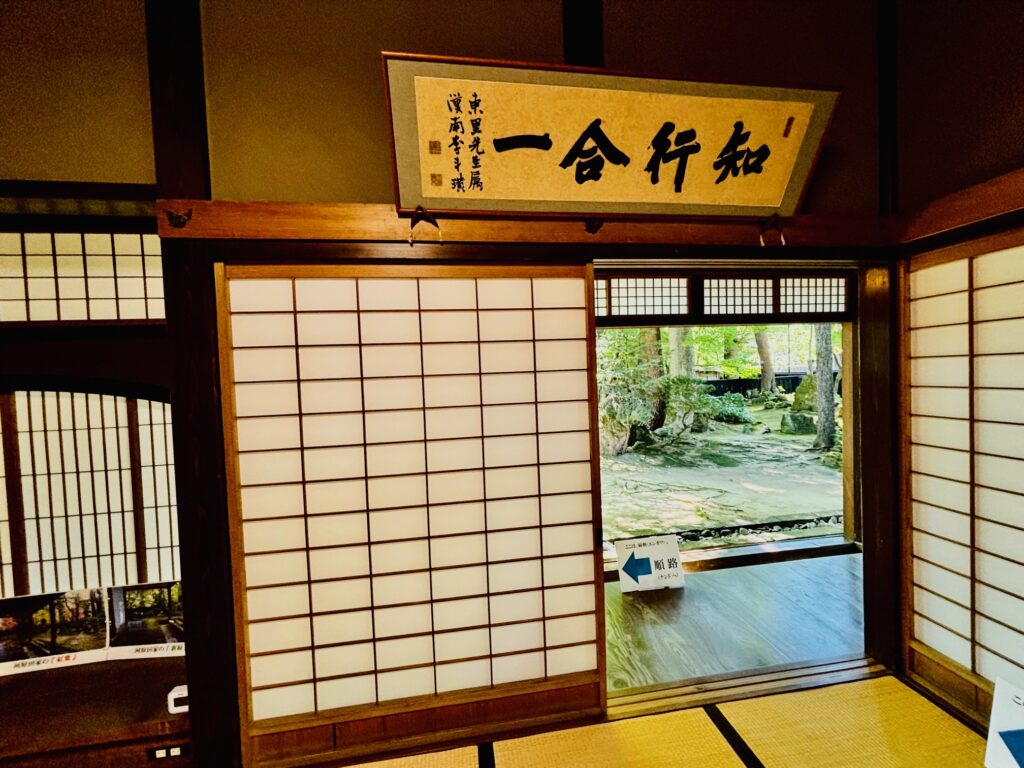
Above the doorway of an old samurai family’s house, and later school in Akita, Japan, hangs a scroll with four bold characters:

知行合一
Unity of knowledge and action.
The characters carry the teaching of 16th-century Chinese philosopher and educator Wang Yangming. It watches over the space where children once learned; guided by a vision of education rooted not only in knowledge, but in how to live wisely. For Wang, insight was incomplete unless it took form in action. Real understanding moved the whole person: mind, will, and conduct together. It was not enough to know in theory. One had to live it.
知是行之始,行是知之成
“Knowledge is the beginning of action; action is the completion of knowledge.“
This principle resonates across traditions, though in distinct forms. In ancient Greece, Aristotle spoke of (phronesis) practical wisdom realised not through abstraction, but through lived ethical judgment. In many Indigenous traditions, knowledge is bound to relationship – with land, with kin, with story – and formed through responsibility, not detachment (Battiste, 2002).
However, in many education systems today, the pursuit of greater unity between knowledge and action is challenged on several fronts.
First, stated curriculum aims are often vague or underdefined. Without a shared understanding of the wisdom, dispositions, and responsibilities it is meant to cultivate, decisions about what knowledge should be sustained, challenged, or enacted become unanchored. By “curriculum” here, the reference is not only to the frameworks of subjects, but to the totality of planned and lived experiences in school through which students encounter knowledge, develop understanding, and form dispositions for living well.
Second, the world has changed rapidly, presenting challenges that curricula have struggled to meet. Children now navigate digital environments, confront ecological crises, and face growing pressures on their psychological wellbeing. Increasingly, they are expected not only to understand the world but are implicated in relating and acting within it.
Third, curriculum implementation tends to privilege certain subjects and default to what is easiest to deliver and measure, narrowing what is seen as valuable. This indirectly limits curricula opportunities to integrate learning into their lives. Ethical and relational dimensions risk becoming peripheral, rather than lived and embedded across the curriculum.
Curricula that operate as delivery systems where, for example, children are taught about ‘healthy eating’ often seem to rest on the assumption that knowing will lead to doing. Yet we have known for years that attitudes do not necessarily translate into behaviours (Ajzen, & Fishbein, 1977). Children being able to label the parts of a healthy plate or recite online safety rules, does not necessarily mean they will go on to choose healthier foods or act safely online. Research in psychology suggests that behaviour changes depend on a much broader, complex set of factors that include how knowledge is emotionally resonant, shaped by habit, motivation, identity, and social context, supported by a sense of agency, and reinforced through practice across varied situations (Blakemore & Mills, 2014; Kahneman, 2011; Willingham, 2009). How can these factors be more comprehensively spoken to within the curriculum?
The Curriculum as Encounter
Curriculum and school culture have a formative potential to shape what children attend to – and how they imagine their responsibility in the world. Gert Biesta points to education as a process of encountering the world, where students are not merely learners, but subjects, called to respond to the world as it is and as it could be (Biesta, 2021). In this “turning of the arrow” outwards (Biesta, 2025), knowledge becomes not only something to master, but something to discern, to reflect upon, and to live toward. A curriculum shaped by such encounters preserves the integrity of disciplines while widening their reach – inviting students not just to know the world, but to meet it.
Action Across Self, Other, World
In some settings, school-based action has come to be associated with activism. However, the forms of action that education can cultivate can be much broader, more grounded, and engage with children’s immediate communities. Such action often unfolds not through dramatic gestures, but through quiet, sustained practices grounded in care and responsibility.
Wisdom, responsibility, and action are both personal and collective. Drawing on Kristján Kristjánsson’s work on practical wisdom and flourishing, these collective capabilities – reasoning together, engaging in respectful discourse, discerning trustworthiness, and reaching wise judgments in common – are not optional extras but essential to sustaining a shared future. Flourishing depends not only on the inner formation of character but on the external conditions – political, institutional, and cultural – that make it possible, drawing on insights from both Western and non-Western traditions.
Traditions and school practices influenced by democratic education movements like Japan’s Tokkatsu exemplify this. Students lead routines, manage resources, tend school gardens, resolve conflicts. These are not “add-ons” to curriculum; they are integral to its aims and design (Fielding & Moss, 2011; Tsuneyoshi et al., 2019). They cultivate agency not as an abstract ideal, but as a lived habit.
As Michael Surkes (2025) writes, wisdom does not require perfect certainty. What matters is whether an idea makes sense, whether it helps others, and whether it works in practice. A curriculum aligned with action gives students space to test what they know – and, just as importantly, to reflect on when and how to act. Not all action is immediate, and not all decisions are loud. Sometimes, wisdom lives in restraint.
Knowledge That Waits and Deepens
Of course, not all knowledge must lead to action. Some deepens our sense of what’s possible, shaping who we become long before it finds expression. There is dignity in learning for its own sake. Its value lies not always in what we do with it next, but in how it forms our inner lives.
A curriculum that connects knowledge with the deeper project of becoming – attentive to the self, accountable to others, and alive to the world – does not abandon content. Nor does it subordinate knowledge to utility. It recognises that knowing and becoming are intertwined in a life well lived.
Letting Knowledge Live
In a world shaped by climate instability, algorithmic drift, and fragile solidarities, education is being called to evolve – not toward a single destination, but into ways of knowing and living that honour complexity and sustain a shared future.
There will be no universal agreement on what knowledge should live, or how it should be lived. Holding space for ambiguity and uncertainty allows tensions to open rich possibilities for reflection and insight.
From above the doorway, Wang Yangming’s teaching of unity in knowledge and action stands – not as a fixed formula, but as a provocation for the way education is conceived.
It offers a challenge to educators to reimagine curriculum as a living encounter between knowledge, responsibility, and becoming. An invitation to cultivate understanding that moves into care, into judgment, and into the quiet, cumulative choices our students will come to make.
With sincere thanks to Dr Julia Flutter for her insightful feedback on an earlier draft.
References
Ajzen, I., & Fishbein, M. (1977). Attitude–behavior relations: A theoretical analysis and review of empirical research. Psychological Bulletin, 84(5), 888–918.
Battiste, M. (2002). Indigenous knowledge and pedagogy in First Nations education: A literature review with recommendations. Ottawa: Indian and Northern Affairs Canada.
Biesta, G. (2021). World‑centred education: A view for the present. Routledge.
Biesta, G. (2025). Turning the arrow: Education after the age of the world‑view. Asia Pacific Journal of Education. Advance online publication.
Blakemore, S. J., & Mills, K. L. (2014). Is adolescence a sensitive period for sociocultural processing? Annual Review of Psychology, 65, 187–207.
Fielding, M., & Moss, P. (2011). Radical education and the common school: A democratic alternative. Routledge.
Kahneman, D. (2011). Thinking, fast and slow. Farrar, Straus and Giroux.
Kristjánsson, K. (2024). Aristotelian practical wisdom (phronesis) as the key to professional ethics in teaching. Topoi, 43, 1031–1042.
Kristjánsson, K. (2025). The proper scope of education for flourishing. Journal of Philosophy of Education, 59(3–4).
Kristjánsson, K. (2025). Reconsidering the “Ten Myths” about Character Education. Journal of Philosophy of Education.
Kristjánsson, K. (2025). Education for human flourishing: A conceptual framework. OECD.
Surkes, M. A. (2025, July 7). Applying coherence, morality, and utility toward developing practical wisdom. University of Chicago Wisdom Research Network. https://wisdomcenter.uchicago.edu/news/discussions/applying-coherence-morality-and-utility-toward-developing-practical-wisdom
Tsuneyoshi, R. K., Sugita, H., Kusanagi, K. N., & Takahashi, F. (Eds.). (2019). Tokkatsu: The Japanese educational model of holistic education. World Scientific.
Willingham, D. T. (2009). Why don’t students like school? Jossey-Bass.
