
The Japanese Tokkatsu Model of Schooling: Educating the Entire Child
School is Life
The COVID pandemic was a strong reminder to many people that schooling is about far more than just learning subjects in the narrow sense. It is also about making friends, discovering what you want to be in the future, and understanding what it means to lead a safe, healthy, and caring lifestyle.
In most countries, these kinds of learning experiences are usually not part of the official goals of schooling. The Japanese curriculum is unusual in that it contains not only subjects such as mathematics, science, and reading, but also non-subject learning hours. One of the pillars of these non-subject hours is tokubetsu katsudō (tokkatsu for short). Sōgō (the period for integrated studies), which emphasizes inquiry, is also a major non-subject learning area.
Tokkatsu, which is at the core of non-subject learning in Japan, currently consists of classroom activities, children’s councils, club activities, and school events (for example, in elementary schools). What is included as non-subject learning has changed over the years, as it reflects evolving ideas of what kinds of school experiences are most productive in developing the whole child, both inside and outside of subjects.
Teacher Research Groups
There are teacher-initiated research groups throughout Japan, at both local and national levels, which bring teachers together from different regions and schools to learn from each other’s experiences. Teachers observe one another’s classes, give presentations, and engage in discussions. These groups disseminate ideas not only about subject teaching but also about non-subject learning. Within schools, lesson study also brings teachers together as a form of collaborative professional learning.
Intrinsically Motivated Behavior
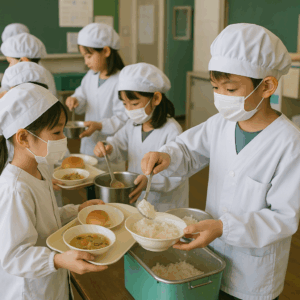
During tokkatsu, children “learn by doing” through collaborative and self-initiated activities. Some of these activities are essential for the running of the class or school, and every child is expected to experience them. Such roles are rotated among the children, such as cleaning and serving lunch. These are called tōban, while kakari refers to roles chosen according to each child’s interests. The distinctive tokkatsu aspect of even tasks like cleaning is that they become the subject of class discussions to explore their meaning. For example, what is the meaning of cleaning? Try thinking of some answers.
- It feels better to study in a clean classroom than in one that is not. What can I do to make the classroom a nicer place for everyone? (class discussion, school events, value education, etc.)
- Cleanliness supports good health, as we learned in class (link with subject knowledge).
- Notice how school staff, such as the custodian, help make the school a better place (appreciation for others, understanding the value of work, value education, etc.)
And we could go on… Small groups called han, in which children clean the classrooms together, are designed to foster this kind of “learning by doing” in collaborative situations. Just as teachers learn collaboratively through lesson study, children learn collaboratively through tokkatsu.
Ryoko Tsuneyoshi
Vice President and Specially-Appointed Professor, Bunkyo Gakuin University | Professor Emerita, University of Tokyo
Further Readings
Tokkatsu, and the holistic model of schooling it represents, has now been adopted in various countries. For example, JICA (Japan International Cooperation Agency) has supported its introduction in Egypt. You can find more “tokkatsu” resources online.
Other sources of information include:
*R. Tsuneyoshi, H. Sugita, K.N. Kusanagi, and F. Takahashi Eds. (2020). Tokkatsu: The Japanese Educational Model of Holistic Education. World Scientific.
*The World of Tokkatsu, which is a translation of material issued by teacher’s research groups on what tokkatsu is. This translation can be downloaded from the homepage of the GMS Research Institute. https://www.gmsresearch.net/⇒English⇒Publications.
